The question came from a reader: “Are we really broke?”
He cited the most recent Financial Report of the U.S. Government for fiscal year 2025. The little-known report was released in March. It came and went with even less fanfare than usual, if that’s possible.
I was thinking about other things. I bet you were, too.
And still are.
According to the report, our government has $6.1 trillion in assets. It also has $47.8 trillion in liabilities. That leaves our government with a negative net worth of $41.7 trillion.
Even Elon couldn’t handle that. Indeed, to cover it you’d need to take over the 72 largest stocks in the S&P 500. (You can see a rank-ordered list here.)
But don’t panic.
By this measure we’ve been broke for a long time. To be precise, we’ve been broke since the very first report. Sadly, I don’t have a copy of the first report in the Burns Library of Obscure and Musty Documents. I gave it to a friend. He was thrilled. (You wouldn’t want to meet him at a cocktail party.)
Fortunately, I do have a copy of the second report. Like the first, it is labeled a “prototype.” It reports on the financial condition of our government in 1976 and 1975. It lists $399.2 billion in assets and $1,625.9 billion in liabilities. That leaves a negative net worth of $1,226.7 billion. You can see the basic pages below.
Page 6 of the report:
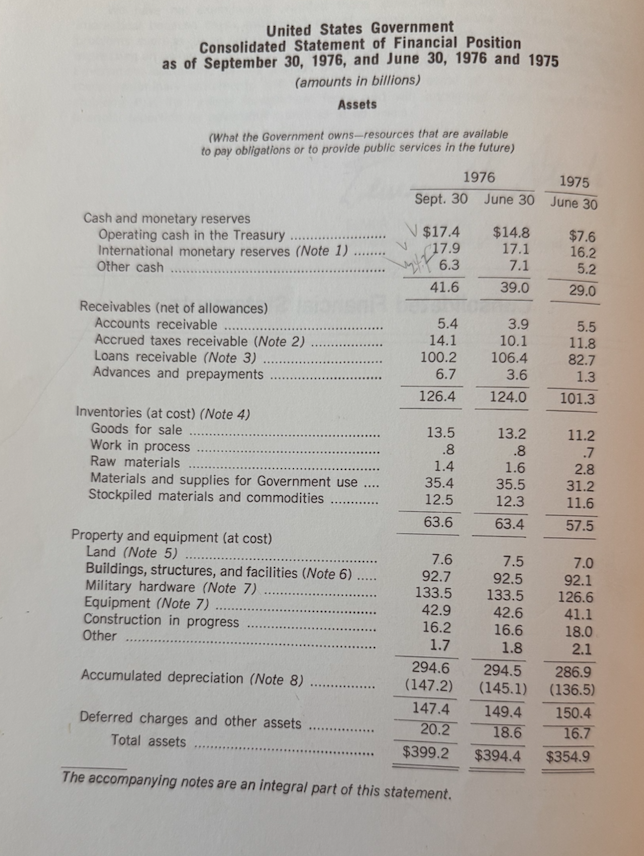
Page 7 of the report:
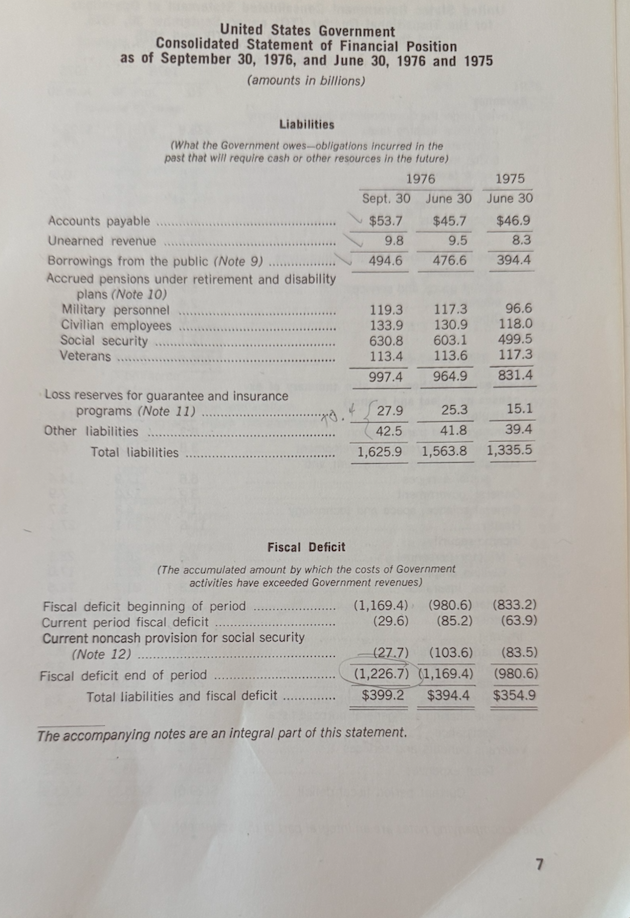
So we’ve been unsustainable and broke for at least 50 years. The only difference is that our brokeness has increased dramatically. We now measure in trillions, not mere billions.
Even the size of the reports is instructive. The prototype report clocks in at 27 pages, including 16 pages of notes. The current report, available in glorious HTML or PDF, takes a whopping 269 pages.
It may be more than you want to know, but the origins of this report trace to a Republican senator from Massachusetts. Leverett B. Saltonstall was a Boston Brahmin of the highest order. Up there with the Cabots. Legend goes, they only spoke with God.
Others with the name were commonly referenced as “he’s a Saltonstall,” as though the person was a brand of car, like a Bugatti or a Bentley.
Saltonstall would likely be considered a terrorist by the current standards of the Texas Republican Party, but his legislation to get this report was practical, not radical. It asked for an accounting of government activities that was akin to the accounting required for American corporations – something that recognized accrued liabilities and off-balance sheet liabilities.
That’s stuff like pension obligations, other government promises, leases and government guarantees that might require future money payments. It would also include long-term benefit promises like Social Security, Medicare and Medicaid.
After the worker pension problems and corporate bankruptcies that followed the OPEC embargo of 1973-74, this was not a radical idea.
So. Are we broke yet?
No. But we are, as multiple government reports have said for years, “on an unsustainable path.” Our politicians have caused our government to promise far more services and benefits than it has the revenue to deliver.
It operates at a deficit, year after year, and both parties point fingers at the other. This has been done every single year of your life. And the 85 years of mine.
So Benjamin Franklin was wrong. He said only death and taxes are certain. But it’s really death, taxes and deficits.
Are we doomed? Are we facing a future of economic collapse, roaring inflation, high unemployment, and misery for all?
I hope not. We can solve the problem – what economists call our “fiscal gap”—by changing the promises our politicians made. Unfortunately, both of our parties are functionally brain dead.
You can experiment with solving the problem by playing with an online tool called “The Reformer.” Created by the Committee for a Responsible Federal Budget, the Reformer lets you play with solutions to financing Social Security, a big part of our unfunded federal promises.
Try it. It’s not rocket science.
The solution exists. It will come from way out in left field. Or maybe right field. Either way, it will be way out.
Related columns:
Scott Burns, “Tell Me: Did 2025 Signal a Sea change for America and the World?”, 1/23/2026:
https://scottburns.com/tell-me-did-2025-signal-a-sea-change-for-america-and-the-world/
Scott Burns, “Here’s Proof We Can Afford the Future… And So Can Our Grandchildren,” 12/29/2025:
https://scottburns.com/heres-proof-we-can-afford-the-future-and-so-can-our-grandchildren/
Scott Burns, “The Supreme Grand Poohbah Saves Social Security,” 5/4/2025:
https://scottburns.com/the-supreme-grand-poohbah-saves-social-security/
Scott Burns, “The Fun Way to Make Social Security Solvent 2,” 10/1/2023:
https://scottburns.com/the-fun-way-to-make-social-security-solvent-2/
Scott Burns, “Can We Fix Social Security?,” 11/5/2023:
https://scottburns.com/can-we-fix-social-security/
Sources and References:
GAO: Consolidated Financial Statements of the U.S. Government, FY 2025 and FY2024, 3/19/2026:
https://www.gao.gov/products/gao-26-108073
2025 OASDI Trustees Report: https://www.ssa.gov/OACT/TR/2025/
2025 Annual Report of the Trustees for Medicare:
https://www.ssa.gov/OACT/TR/2025/
Congressional Budget Office: The Budget and Economic Outlook: 2026 to 2036, 2/2026:
https://www.ssa.gov/OACT/TR/2025/
Peter G. Peterson Foundation: Interest Costs on the National Debt:
https://www.pgpf.org/programs-and-projects/fiscal-policy/monthly-interest-tracker-national-debt/
Committee for a Responsible Federal Budget: “The Reformer: An Interactive Tool to Fix Social Security”: https://www.crfb.org/socialsecurityreformer/
Bureau of Labor Statistics Inflation Calculator:
https://www.bls.gov/data/inflation_calculator.htm
Slickcharts rank ordered list of the market capitalization of the S&P 500:
https://www.slickcharts.com/sp500/marketcap
This information is distributed for education purposes, and it is not to be construed as an offer, solicitation, recommendation, or endorsement of any particular security, product, or service.
Photo: Photo by Nicola Barts : https://www.pexels.com/photo/hand-of-a-man-holding-a-bill-with-past-due-stamp-7926666/
(c) Scott Burns, 2026