I have to say, I’m surprised to still be here. As a child I wondered if I would live to turn 60 in the year 2000. Later, as a testosterone-sodden male in my late teens, I preferred the notion of dying with drama in a fast car, following in the tire tracks of James Dean.
But here I am, 85. Healthy. Likely to persist. Perhaps 10 years. Maybe longer, if the actuarial questionnaire at Healthy Life Expectancy Calculator at the Goldenson Center for Actuarial Research at the University of Connecticut is any indication.
What got me here? It wasn’t my family history. My mother died at 57. Her mother died very young, of tuberculosis. A very Irish story. My father died at 43, a homicide or an accident in North Hollywood as I entered college. The only hint of longevity in my scruffy family tree is an obituary headline for my paternal great grandfather, Thomas Burns. “Nonagenarian Succumbs” it reads, just below a photo of a smiling, thin man holding a violin.
Born in Scotland and destined to become a photographer, he likely couldn’t attribute his longevity to a childhood diet of haggis or anything else on the Scottish menu.
So luck. Pure luck. We love to talk about intentions, plans and action. But you really can’t spend many years on this planet without realizing the truth in, “Man plans, God laughs” — an old Yiddish saying.
More comes from chance than from planning and intention. So much more. Failure to recognize this is just plain arrogant. The failure also shrinks our opportunity to feel genuine gratitude.
Thankfully, utter devotion to a plan isn’t necessary. Neither is perfection. This should give all of us a flutter of hope.
Many readers will shake their heads, skeptical of my claim.
But it appears to be true. I offer my continued existence as an example. This could involve a lot of dreary detail, down to my dental history. But I will spare you. Let’s just say that I was not a model of longevity-fostering behavior for the last 85 years. I simply matured slowly, in the manner of many men, and drank less, stopped smoking at 30 and started to lose the “dadbod” in my mid-60s.
Nothing heroic. Pretty indicative of being a slow learner.
So, dear reader, if you’re 50, 55, or 60 and have become discouraged please take heart. Take a few steps. Start moving. Do it every day. Eat a bit less. Be a tad more watchful. Become aware of your habits.
Do that, just that, and you’ll have a good chance at living a longer and healthier life.
I’d say let’s drink to that, but let’s just say we raised a glass.
Related columns:
Columns on longevity here: https://scottburns.com/category/life-expectancy/
Age 84: Scott Burns, “Learning how to retire,” 11/17/2024: https://scottburns.com/learning-how-to-retire/
Age 84: Scott Burns, “Retirement 2.0: Another Life,” 10/10/24: https://scottburns.com/retirement-2-0-another-life/
Age 80: Scott Burns, “Beginning My Second Life,” 11/8/2020: https://scottburns.com/beginning-my-second-life/
Age 75: Scott Burns, “Why It’s A Good Thing To Live Beyond Age 75,” 11/8/2015: https://scottburns.com/why-its-a-good-thing-to-live-beyond-age-75/
Age 70: Scott Burns, “The Amazing Half-Full Glass,” 11/7/2010: https://scottburns.com/the-amazing-half-full-glass/
Age 68: Scott Burns, “A Meditation on McDonald’s,” 2/22/2009: https://scottburns.com/a-meditation-on-mcdonalds/
Age 65: Scott Burns, “The Future of Old,” 11/6/2005: https://scottburns.com/the-future-of-old/
Sources and References:
Healthy Life Expectancy Calculator at the Goldenson Center for Actuarial Research at the University of Connecticut: https://apps.goldensoncenter.uconn.edu/HLEC/
This information is distributed for education purposes, and it is not to be construed as an offer, solicitation, recommendation, or endorsement of any particular security, product, or service.
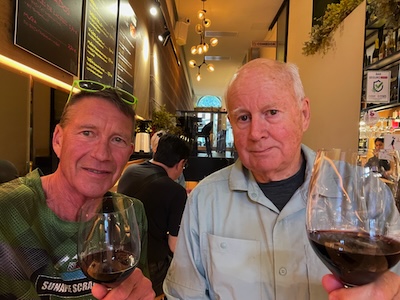
Photo: Scott Burns, 6/10/2024, raising a glass with my brother Doug Blasius, after another day of walking the Camino de Santiago.
(c) Scott Burns, 2025
14 thoughts on “Smiles at 85”
Comments are closed.
Scott,
Choices whether smoking, drinking, eating, working out, doing drugs, attending events with large crowds, etc are all activities that can influence your life line…a person’s mental attitude might be the key for longevity.
Or as my Dad would say: c’est la vie
Here’s to many more years!
regards,
Bill
Scott,
Happy Birthday!! And thanks for your great advice over the decades.
Leonard
Scott
Quote, “I simply matured slowly, in the manner of many men,”
I stopped chewing tobacco at 40, stopped heavy drinking early 30’s, got married first and only time at 42. Today have 3 adult girls and 7 grandkids all girls. Go to church every Sunday that is possible. Started lifting weights and working out about 45.
Both my grandfathers died at 66 and 69. My Dad made it to 88, but from 75 on he had a surgery about every year. We called him the cat with 9 lives.
Today I am 70 and can’t believe I am still alive either.
The Lord be with you
Tim
Happy Birthday Scott, and thanks for your insightful columns in the Houston Chronicle, which kick stated my financial literacy journey!
Delighted to have been helpful!
“Many readers will shake their heads, skeptical of my claim.”
Yes, I am among those shaking my head.
“More comes from chance than from planning and intention.”
I don’t think that even you believe that, because you then advise: “Take a few steps. Start moving. Do it every day. Eat a bit less. Be a tad more watchful. Become aware of your habits.”
The investing analogy would be to mistakenly think that that one gains wealth, not from planning and intention, but just pure chance. No.
Moving towards wealth come from starting to save, keeping the discipline of consistently saving in low, or no fee investments, rebalancing regularly and becomes aware of one’s bad spending habits and doing a bit less of that.
Sure, the “luck” of where and when one starts their wealth OR health journey will increase or decrease one’s ultimate return on investment, but, a disciplined and consistent approach will increase the chances of success.
Chance, by definition, is not an all-or-none deal. There are people who don’t plan at all but by virtue of their parents wealth can remain wealthy virtually in spite of themselves. Some can remain healthy for similar reasons. Others can be disciplined and careful in both their investing and health practices and still die of cancer, stroke or heart attack. Not to mention the rare airplane crash, or falling from a ladder while putting up Christmas lights.
“Chance favors the prepared mind” — Louis Pasteur
It certainly does. In my case, it was a bit of modestly prepared, better late than never…
Congratulations and Happy 85th! What exactly is healthy years? What disability would qualify as the start of the non-healthy years?
Pls write an article on when/how to decide to move to independent living in a CCC vs independent living at home.
Thank you for your columns over the years!
Researchers have created a metric called DALEs (Disability-Adjusted-Life-Expectancy) in which they attempt to give less “credit” to years spent with less than full health. Others, like the U of C Center try to distinguise between healthy years and not-healthy years. The whole business is less-than-exact because measurement of disability varies greatly.
Here’s an example. Loss of hearing is considered a disability. But it’s all a matter of degree. Some people are able to adapt pretty well with hearing aids. Others may do without hearing aids but avoid certain circumstances, like tables in the middle of the room in noisy restaurants.
I have notes for an article on the distribution of disability and death by age and hope to get it written before the end of the year.
The independent living vs CCRC decision depends on so many factors that it’s hard to say “This is exactly when…” But the biggest single factor is whether you have support for staying in your home. If all your adult children live in different parts of the country and none live nearby, you’re a good candidate for choosing to move and get both the institutional support of a CCRC and the seldom discussed but really important support from your peers who have made the same decision.
Looking forward to your future column “on the distribution of disability and death by age,”
Also your evolving thoughts on when and how to assess a CCC. God bless!
Seems you are confirming Machiavelli who stated that fortune governs about half of human actions, leaving the other half to be influenced by human will and skill.
I hope your good fortune continues and your sharing of lessons on will and skill. I’m a long-time reader and have learned a lot from you’re columns. Cheers to your health!
Thank you!