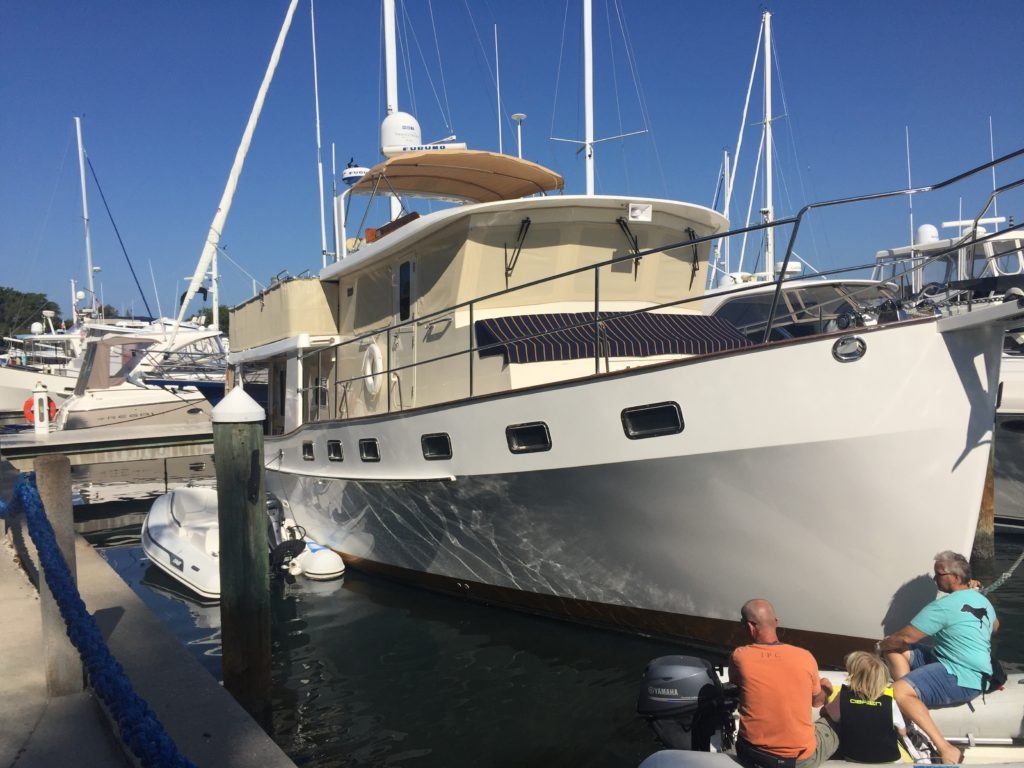
Wednesday brought surprising news. Kadey-Krogen, a near iconic yacht builder in Florida, declared Chapter 7 bankruptcy. It would be liquidated. Boats would not be completed. Deposits on boats being built would be lost.
These are not mega-yachts for oligarchs and billionaires. They are single-engine yachts that can, and do, serve as floating first or second homes for everyday millionaires, the sort of people that have been described as the “mass affluent.” It would be very easy, for instance, to make a case for choosing a used Kadey-Krogen 42 in a Florida marina over spending three or four times as much to buy a two-bedroom, two-bath condo in the same area. Ditto most of the entire East or West Coast. Sadly, tariff uncertainty was a major factor in the bankruptcy.
Six months earlier, Catalina Yachts declared bankruptcy. The event served notice that sailboats were in tough times. Millions of sailors learned on Catalina 22s and became boat owners with the thousands of Catalina 27s, 30s and 32s the company produced. I’ve owned a Catalina 32, kept it in Annapolis and loved it.
No Kleenex Will Be Provided
I am not writing this to bemoan the death of yachting. (A yacht is defined as a boat that is at least 30 feet long. Statistics suggest 95 percent of the boats Americans own are smaller.) Instead, I’m wondering if we’ve hit Peak Yacht, the moment boat ownership hits an all-time high rather than just another economic ebb tide.
While boating is a massive and highly visible industry, it has been estimated that only 12 percent of households own a boat. So the other 88 percent aren’t likely to shed tears about something they either didn’t want or couldn’t afford.
The K-Shaped Economy
It is popular to describe our economy as K-shaped, with higher income, higher wealth households constantly gaining ground, while lower income, lower wealth households relentlessly lose ground. The discussion makes it sound as though the higher income group is bulletproof. It imagines that the lower income group takes all the hits.
But it’s more soundbite than reality. Affluent families can also take hits that are devastating. Premature death, divorce, addictions and job loss are broadly distributed.
Possible Causes of Peak Yacht
There are five likely reasons the boating world is in trouble. Here’s my list:
–Crowding. Growth changes what we experience. Many of our recreational water spots have become as overcrowded and unpleasant as airports. But more dangerous. While the number of people with boats has increased, the number of people who have learned (or obey) basic “rules of the road” seems to have declined. The most recent Coast Guard statistics show a decline in boating deaths but an increase in nonfatal injuries, a possible indication that we are better protected but less careful.
–Luxuryizing. More boaters trying to share the same amount of waterfront has created opportunities for marinas to upgrade their facilities and prices. They trade their casual customers for customers seeking a luxury experience.
–Overreach in Boat Operating Expenses. A saturation number of boaters means more demand for the limited supply of people with the skills needed to keep boats afloat and running. Think diesel mechanics. It also creates opportunities for opportunistic price gauging. Boaters then have a choice: Learn a broad range of skills, pay a fortune in charges, or abandon boating.
–No Lower Rungs on the Ladder. Over the last 20 years, boat builders have put increasing emphasis on their newest, largest and most expensive boats. Entry level boats have been largely ignored. You can see this in any boating publication. The advertising dollars are spent on the newest and largest boats. The boats with the highest price tags. This does nothing to foster a population of future boat buyers.
–A Generational Sea Change. Younger, would-be boaters were raised digitally, a path that often creates illusions about the physical requirements of living in the world, getting things done and making things work. I say this as an observation, not as a judgment. But changes have consequences. This change makes younger people less likely to want to own objects that need tending and tinkering.
Portents of Doom?
Some could turn this into yet more reasons we are all doomed. I think it’s just an interesting change in a world all of us are ill-equipped to grasp.
If you’re part of the boating world, or have thought about owning a boat, please share your observations.
Related columns:
Scott Burns, “Staying Afloat And The Rush For Stuff,” 7/3/2021: https://scottburns.com/staying-afloat-and-the-rush-for-stuff/
Sources and References:
Paul Leighton, “Journal of America’s first pleasure yacht goes to auction,” 8/9/2022: https://www.yahoo.com/news/journal-americas-first-pleasure-yacht-140100284.html
Cleopatra’s Barge: https://salempl.org/wiki/index.php?title=Cleopatra%27s_Barge
Daniel Kline, “50-year-old boat building files Chapter 7 and won’t deliver,” 7/15/26: https://www.thestreet.com/retail/50-year-old-boat-builder-kadey-krogen-files-chapter-7
Veronika Bondarenko, “An iconic sailing company declares bankruptcy and shuts down after 46 years,” 1/6/2026: https://finance.yahoo.com/news/iconic-sailing-company-declares-bankruptcy-194700408.html
Yachtworld search for Kadey-Krogen yachts for sale: https://www.yachtworld.com/boats-for-sale/make-kadey-krogen/
This information is distributed for education purposes, and it is not to be construed as an offer, solicitation, recommendation, or endorsement of any particular security, product, or service.
Photos: Scott Burns, a Kadey-Krogen dockside in Longboat Key Marina, 2018
(c) Scott Burns, 2026
10 thoughts on “Have We Hit ‘Peak Yacht’?”
Comments are closed.
Not a boater but have friends and family with boats including a Catalina 32 here in DFW. I was surprised to learn the other day from a boater that you should expect to spend 10% of the new price of a boat on maintenance every year.
I’m reminded years ago reading one of Andrew Tobias’ books on personal finance with the advise to have friends with boats and bring them a bottle of champagne or lunch/dinner when you get invited on the boat.
Hi James. The metric I’ve heard most often is that the total operating cost of a boat is about 20 percent of its cost. Either way –10% maintenance, 20% total operating — the costs make selling a boat as big a thrill as buying one. And Tobias was right on. Some of the best boating trips I’ve taken were with my friend Walt on his Nordic Tug 42. I served as his deck hand and short order cook and we cruised the ICW on the Florida gulf coast. He was good company, but it was also a relief not to face any expenses beyond the diesel and dockage expenses that we shared.
I’ve never owned a power boat but I’ve owned four sailboats, two wood hulls, two glass hulls, and all required constant work… or constant bills. Still, I love being on salt water!
“Younger, would-be boaters were raised digitally, a path that often creates illusions about the physical requirements of living in the world, getting things done and making things work.”
Could you unpack this?
What are the illusions that younger people are under?
Thanks for asking!
Since the creation of the World Wide Web we’ve all been living in a world that suggests everything should be both immediate and free. This applies to people of all ages.
The same illusion fosters a sense that everything can happen with no actual effort, or ought to. So we are all less patient, more easily frustrated when something doesn’t happen quickly. We live on a fast food clock.
Many young people have limited experience with the physical world. One of the best ways to reduce the chance that your car will be stolen is to have a manual transmission rather than an automatic transmission. Many young people have never changed a tire, don’t know where their car battery is, etc. This goes well beyond basic automobile knowledge. With ever more time being spent on screens, there is less time spent on physical engagement with the day-to-day world.
Scott
I think this trend also applies to RVs and motorcycles. The larger, more expensive (to purchase and maintain) motorhomes are Class A diesel pushers. The current RV industry trend is to small trailers or vans (Class B). The existing customer for Class As are aging out. Shop rates are over $200/hour and there still is a 3-month wait time sometimes. The younger generation are going smaller, simpler.
The large motorcycles are seeing the same issue. Less Harley Davidsons, more street races.
It absolutely does! Just checkout Facebook marketplace. It is filled with older Airstreams, multitudes of RVs, and swarms of motorcycles.
We’ve owned an older pilot house 47’ cabin cruiser for 12 years. We spend 4-5 summer months on it in the Pacific Northwest. We are pretty hands on for maintenance but still hire out about 50% for larger repairs and retrofits. Is it expensive? Much cheaper than owning an ocean front house or condo! The boat does not appreciate but is well maintained and worth about what we have into it. We do own our slip and it’s now worth more than our boat. We are almost totally self contained and spend about 1/2 time at anchor. Usually just go to marinas to re-provision, some socializing and a meal out. We love our lifestyle and it’s what we choose to spend a big part of our discretionary income doing it.
Btw, I’ve been following you for about 25 years. Your writing has taught me a lot! Thank you Scott!
Thanks for the kind words!
Your cabin cruiser schedule sounds perfect. The case for substituting a yacht (trawler or cruiser) for a house or condo gets better and better as you exercise more independence and don’t go where everyone else goes. That way you can avoid or minimize marina charges and avoid most of the expenses attached to luxury destinations. It helps a lot if you like to do some of your own work rather than have boatyards handle it all. I still think about boats. These days I’ve shifted from the sailboats that I have owned over many years to thinking about a live-aboard power boat.
I think this trend also applies to RVs and motorcycles. The larger, more expensive (to purchase and maintain) motorhomes are Class A diesel pushers. The current RV industry trend is to small trailers or vans (Class B). The existing customer for Class As are aging out. Shop rates are over $200/hour and there still is a 3-month wait time sometimes. Private campgrounds are converting to resorts with increased amenities and fees ($100-200/ day). The younger generation is going smaller, simpler.
The large motorcycles are seeing the same issue. Less Harley Davidsons, more street racers.
I’ve also owned a few sailboats. Nothing better than having the sails trimmed just right and the boat cutting through the water! That sound is just perfect.
We now own a Class A so we can see the rest of the country.
Years ago, I went to a big RV gathering in Quartzite, AZ. RVs of all kinds there, but I was amazed at the number of class A RVs until I talked with a few owners and found out how many had worked for Cummins and felt at home repairing everything diesel. They never had to deal with $200/hr shop rates, had impressive solar/wind installations, and loved boondocking. I enjoyed having a 23′ Airstream “Land Yacht” for a few years and working on it, but even that RV parks in Red River never brought the pleasure of salt water sailing!