
For decades, investment theory said one thing. Actual results said another. A striking comparison of investment results for 2025 suggests we may be on the cusp of major change.
Investment theory says diversification is a good thing. We reduce risk by owning many stocks or bonds. We don’t bet the ranch on a single stock or bond. We reduce risk and increase return by owning multiple asset classes. We don’t just pile into one asset class. Sophisticated math, such as mean variance optimization, supported the idea. Lots of people believed it. Wall Street “quants” loved it. I must admit admiring it. There is nothing quite like elegant math.
Reality, however, failed to follow theory. Year after year, an easy, simple portfolio kept producing higher returns than more “sophisticated” portfolios with the required multiple asset classes.
Until 2025.
You can see this by comparing two versions of the Couch Potato portfolio at different time intervals over the last 35 years. One is the most basic, two-part Couch Potato portfolio I have been writing about since 1991. The other is a three-part Couch Potato portfolio.
It’s the one I jokingly referred to as the Margarita portfolio. It had three parts, not two. I named it in honor of the drink favored by the late Jimmy Buffett – not to be confused with Warren Buffett — and his millions of parrothead fans.
You can see the change by scanning down the comparison of end balances for the two portfolios in different time periods from 1991 to 2025.
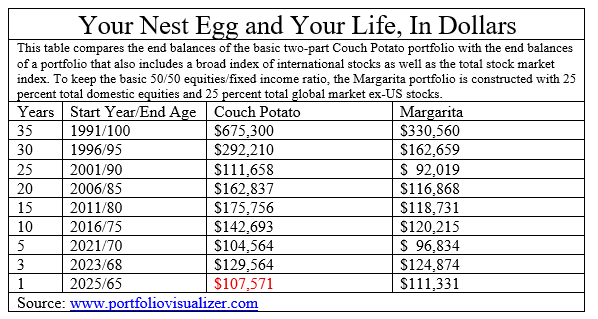
The basic Couch Potato comes out ahead in every period but one, 2025. But International Stocks, with a 32.35 percent return in 2025, nearly double the 17.1 percent return of the total stock market return, allowed the Margarita portfolio to pull ahead of the basic Couch Potato for the year.
That raises a big question.
Was 2025 a flash in the pan? Will the rise of international stocks will be as ephemeral as the overreported death of balanced portfolios?
Or has our world changed in some fundamental way? Has something happened to make international stocks an addition that will improve portfolio performance for many years in the future?
These are questions that have opinions today. But I don’t know the future. Neither do you. And neither does anyone on Wall Street.
Here’s a list of some, just some, of the things that could be indicators of a sea change. Feel free to add your own.
— The federal deficit is out of control. While there have been predictions of the collapse of the dollar and runaway inflation due to deficit spending since the end of World War II, it never happened. But we now have a huge structural deficit. And no prospect for bringing it down. The interest expense of servicing the federal deficit now exceeds $1 trillion a year and is larger than military spending.
— Social Security, despite huge employment tax revenue, is running at a deficit that will exhaust the Social Security Trust fund by 2033. There is no plan on the horizon that will change this. The result will be either privation for millions of retirees or major inflation. Or both.
— The entire post-World War II trade structure is breaking up, threatening the dominance of the dollar. Alliances that have fostered global trade and massive, sophisticated supply chains are ending. Tariffs shift trade. They also work to increase business costs and consumer prices.
— Civil order (and civility itself) is disappearing. Discussion and negotiation are weakening. Resorting to threats and force is rising with authoritarian leaders. This includes an American president who defies the law and has neutered virtually every member of what used to be the Republican Party. In Texas, the state I have happily called home since 1985, the Republican P arty that I once respected and voted for has become a kind of Texas Taliban, blotting out freedom of choice at our universities and seeking to control everything from the state level.
So let me know. Do you think this is temporary? Or permanent? Do you think it’s time to hedge your bets on the future with a commitment to international equities? Have you already done it?
Related columns:
Scott Burns, “The Pudding Report, 2025: Couch Potato Retirees, Better Off Than Ever,” 1/18/2026: https://scottburns.com/the-pudding-report-2025-couch-potato-retirees-better-off-than-ever/
Scott Burns, “The Pudding Report, 2024: Simplicity Is Freedom,” 3/23/2025: https://scottburns.com/the-pudding-report-2024-simplicity-is-freedom/
Sources and References:
The data/software source for the Pudding Report is www.portfoliovisualizer.com
This information is distributed for education purposes, and it is not to be construed as an offer, solicitation, recommendation, or endorsement of any particular security, product, or service.
Photo: Scott Burns, 7/10/22: Wind Song, my Catalina 32, and flag in a slip on the Eastern Shore of the Chesapeake. I sold the boat and, more recently, Catalina has stopped all production and dealers for sail and power boats are going out of business.
(c) Scott Burns, 2026
Letting politics influence your investment decisons has historically always been a mistake.
This article makes it sound like you are getting very close to making this mistake.
Yes, that’s exactly the fear I have. But investment decisions aren’t made in a vacuam. They are made in a social/political context.
And that context appears to be changing.
From the end of World War II until recently, we had a context that favored international cooperation, increased trade, building mutual interdependence and trust.
We now have a President and his adminstration that aim to reduce immigration, if not eliminate it, rebuild domestic manufacturing, end long established relationships of mutual trust, and build Fortress America. That isn’t done without consequences that likely mean a lower value for the dollar, more inflation, and greater federal deficits.
These are troubling times, a rupture in deed.
We do not seem to be pulling together as much as pulling apart. It may be that we will see a shift to some semblance of unity, and yet the disparate sides do not trust government. The president’s team is dismantling government rapidly as it does not please them, excepting massive funding of the new national enforcement branch of government. The opposition, who respects the idea of good governance, cannot trust the current government as the Rs are nurtured, the Ds ineffective, and competent government employees are being replaced with incompetent loyalists. Foreign policy now includes alienating friends, retreating from helping others, disrespect of persons, laws, norms, and the environment. Retreating from modern science, (esp. health and energy), support for burning coal and oil instead of renewables, and favoring Moscow policies with regard to Europe.
Options to dollar denominated trade are becoming more available and accepted. On top of all that, we have massive structural debt as you mentioned. The rest of the world is also heavy on dept. Not seeing a currency of safe harbor. So, given that background, what might be expect? My guess is a weaker dollar, real assets go up in value, inflation/debasement of the dollar. Best case scenario we muddle through, worst case some very dangerous and difficult national and global disorder while a new world order gets sorted out.
That sounds like a sea change to me.
Hi Scott, long time reader of our posts. As much as I feel the tide is changing making overseas investing more appealing, it still concerns me.
Broadly speaking, there seem to be semi-socialist to fully socialist countries like the those in the EU or countries run by dictators, strongmen etc. ( Brazil, Russia).
The rule of law is either too overpowering to draw capital (see the EU) or the lack of it scares capital away ( See Venezuela, China).
And as you noted, we’re dealing with the same insanity in our own country, where the rule of law is ignored and stepped on.
Recently, I read the “Red Notice”, perhaps the best business book I’ve ever read. It was a reminder how unstable the world is when investing in countries like Russia.
It seems that Australia with it’s vast mineral resources is part of a diversified overseas portfolio. But it’s only a country of 26M people.
Thank you for your posts.
David
And as you noted, we’re dealing with the same insanity in our own country, where the rule of law is ignored and stepped on.
— There’s something in just noticing that the things we once counted on to make American economic choices better than economic choices elsewhere are being removed. Accounting quality. Regulation quality. Rule of law rather than rule of power. Etc.