Sooner or later, health care stops being abstract. Something happens to make it “up close and personal.” For me, that something is called atrial fibrillation. It’s a condition caused by excess electrical impulses that make the atrium of my heart quiver rather than pump a steady supply of blood.
It can be debilitating, but mine hasn’t been. It can also be deadly, leading to a stroke or death. While AFib can occur at young ages, it happens more frequently as we age, rising rapidly in our 60s. It becomes very common if you live into your 90s. According to the Centers for Disease Control (CDC), an estimated 12.1 million people in the U.S. will have AFib by 2050. You are more likely to have it, or get it, if you are of European descent or elderly. More women have it than men because they live longer.
You’ve read the depressing part. Most people will find the rest of this column encouraging — about the practice of medicine, about aging and about the likely future.
Here’s the Story
I was diagnosed with AFib 20 years ago, in 2007. I was 66 years old. Prior to the diagnosis, my only health worry was my weight and cholesterol. Here’s the first clue about how much treatment has improved. Back then, none (yes, none) of the doctors I saw could answer when I asked how long my moments of AFib lasted. I was prescribed Warfarin, which is basically rat poison, to thin my blood. I was also prescribed one of the drugs that can control the condition.
Today, my Apple iWatch reports on any AFib. Every day. So do other personal health tools. It’s everyday technology, on your wrist.
My First Ablation
The condition was well-controlled until I came down with Covid-19 in early 2022. That led to having my first ablation at midyear. Ablations are done by inserting a catheter in a groin vein and working it up to your heart. Ablations once destroyed the offending nerve tissue with heat. Heat was superseded by cold. Cold was used for my first procedure.
That first ablation resulted in zero AFib and the elimination of AFib-related drugs. I was healthy enough to walk the 480-mile French route of the Camino de Santiago de Compostela across the Pyrenees in 2024 at age 83. You can read some of the columns about that here.
A New Kind of Ablation
This January, I caught Covid again. My AFib returned, accompanied by what I experienced as a significant loss of energy. In May I had another ablation. This procedure used a new technique, pulsed field ablation. It reduces risk of damaging nearby non-heart tissue, is more focused and takes less time than earlier methods. That means less time under full anesthesia – a major consideration for the elderly — and a faster recovery.
You enter the hospital in the morning. You are discharged in the early afternoon.
Result, no AFib. No AFib drugs. Energy restored. If it holds for five years, as the first one did, I’ll be approaching my 91st birthday. But the expectation is that it may hold even longer. Indeed, the change in the procedure and the reduced time under full anesthesia could also mean that another procedure might be done if it becomes necessary.
The Chasm Between Billing and Paying
And the cost?
Well, the idiocy of Chargemaster medical billing continues. The total billed by the hospital, doctors and related services was a hefty $558,000. My Humana insurance paid $26,000. That’s 4.7 percent of the amount billed. Lots of absurdity there.
My cost? $400. Either way, it is a small price to pay for additional years of full, productive living. I’m thinking about celebrating by walking another Camino, perhaps the shorter Portuguese Camino.
And what about medical inflation monster?
Five years earlier, Chargemaster billed $319,000. Insurance paid $21,000. And I paid $50. If that $21,000 rose with the CPI-W, the Bureau of Labor Statistics inflation calculator tells me it should have cost $23,753. So the actual cost of the improved technology was $2,247.
Sounds like a good deal to me. What do you think?
Related columns:
Scott Burns, “A Heartening Experience,” 10/22/2022: https://scottburns.com/the-insanity-of-hospital-billing/
Scott Burns, “Camino De Santiago” search: https://scottburns.com/?s=Camino+de+Santiago
Sources and References:
Kevin G. Buda, DO, FACC; Jay Sengupta, MD, FACC, “Smart Watches and Atrial Fibrillation: What Works and What Needs Improvement?,” 5/29/2024: https://www.acc.org/latest-in-cardiology/articles/2024/05/29/16/56/smartwatches-and-atrial-fibrillation
The Many Routes of the Camino www.caminoways.com: https://caminoways.com/camino-de-santiago-routes?gad_source=1&gad_campaignid=22372276797&gbraid=0AAAAADq80ejv7HYTLG5SOqjoOq5O_gi21&gclid=Cj0KCQjwh4TVBhCWARIsAG0czmrmukEBrcu0p9CvJUb95ZQQxZ5EYk9YWWlZIuI1BmMs7JlLmnmdjEAaAn-cEALw_wcB
Cleveland Clinic, “Pulsed-Field Ablation: A New, Highly Selective Catheter Ablation Method for Heart Arrhythmias,” 1/17/2024: https://consultqd.clevelandclinic.org/pulsed-field-ablation-a-new-highly-selective-catheter-ablation-method-for-heart-arrhythmias
Bureau of Labor Statistics Inflation Calculator: https://www.bls.gov/data/inflation_calculator.htm
This information is distributed for education purposes, and it is not to be construed as an offer, solicitation, recommendation, or endorsement of any particular security, product, or service.
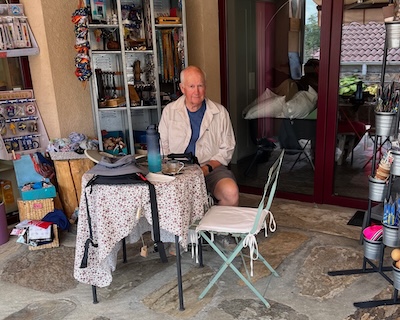
Photo: 6/24/24 Resting along the Camino in El Ganso, photo taken by my brother Don.
(c) Scott Burns, 2026