
Thanks to a strangely named website, www.dqydj.com, the first data from the 2025 Federal Reserve Survey of Consumer Finances was available almost instantly.
The immediate message? Americans are wealthier than ever.
(Those website initials stand for “Don’t Quit Your Day Job.” Still good advice in 2026.)
But The Young Were Behind The Door
Some, however, are much wealthier than ever. And some have more dollars, but can’t buy more than they did in 1998.
That’s what happens when the assets preferred by the better off provide better returns than the assets chosen by most people.
Let’s take a look. The table below shows the level of net worth at the bottom of each percentile rank in the table. We’re looking at the top 1, 5, 10, and top 25 percent and median (50th percentile) of all U.S. households. I haven’t included lower levels because I have yet to meet anyone who wants to be less than median. We continue to aspire to Lake Wobegon, where everyone is above average.
You can find out exactly where you stand by going here.
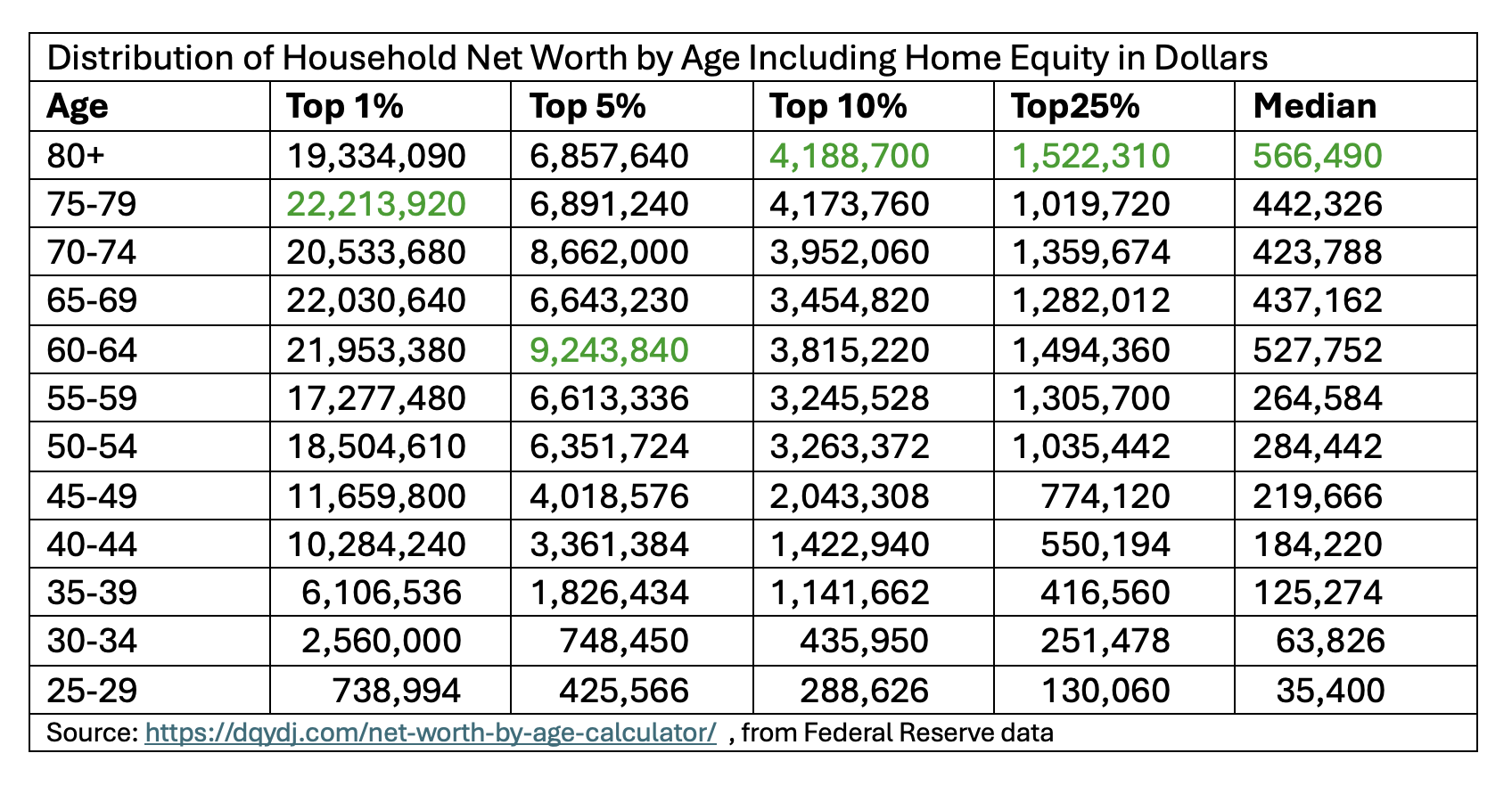
The first thing I noticed: The peak wealth pattern that prevailed in earlier surveys has disappeared. In those surveys, wealth peaked when households were in their 60s. After that, it declined. It was assumed that households realized they could safely spend assets or distribute them to children or charities. Also, household net worth tended to rise smoothly with age.
No more.
Today, wealth is highest among those 80-plus years old! Yes, you read that right, households in their 80s.
Wealth peaks at age 75-79 for the top 1 percent. Mysteriously, it still peaks in the early 60s for the top 5 percent. I’m wondering how long it will take conventional media to realize that the “plight of the young” deserves equal billing with “plight of the elderly.”
Wealth Is Now A Roller Coaster Ride
Skeptics can start with a single sentence on page 13 of the just released report on changes since the last report: “Net worth declined substantially for the youngest families, while exhibiting large gains for the oldest.”
Building wealth is also more of a roller coaster ride than a smooth climb.
The wealth of the top 25 percent households, for instance, reached $1,494,360 at ages 60-64, then declined, rose, and declined to $1,019,720 for age 75-79. Then it soared for those 80-plus, rising to $1,522,310.
Now look at the 1998 table.
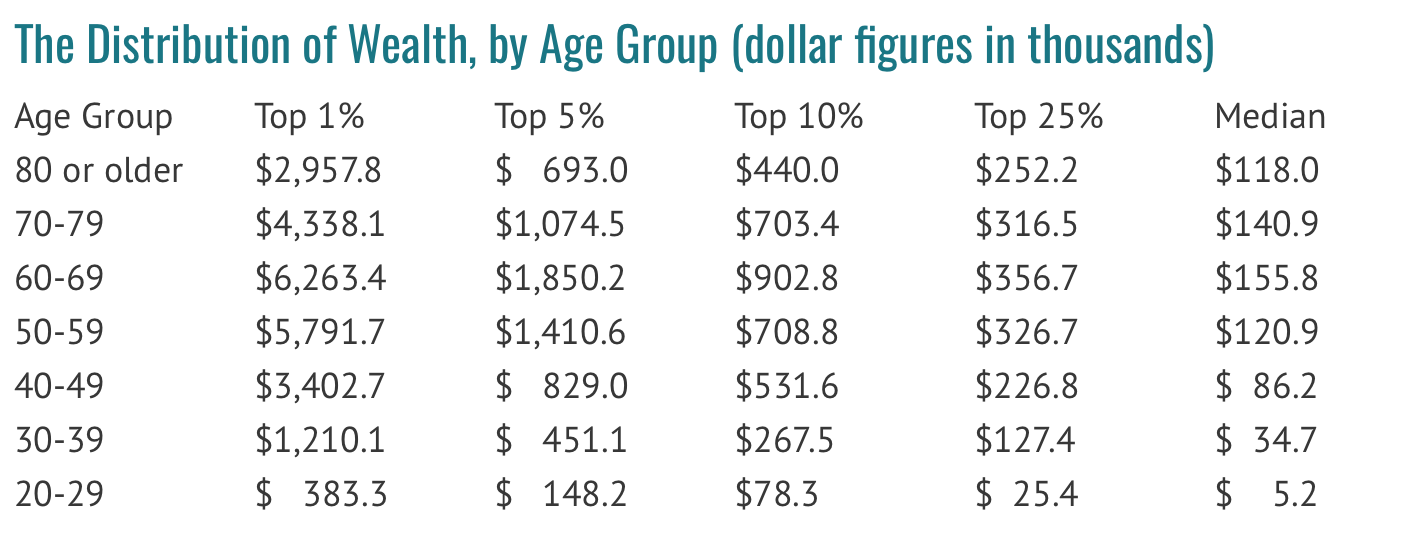 Source: The VIP Forum, Corporate Executive Board, 1998 data
Yes, net worth was a lot smaller then. We can’t do an exact inflation adjustment due to limits of government consumer price index data, but keeping up with inflation would mean that every one of the 1998 figures would have to be doubled.
That’s no problem for the 80-plus top 1 percent. They’re up six times. Wealth in their 60s is up three times.
The 80-plus for the top 10 percent are up nearly 10 times from 1998. The top 25 percent of this age group is up six times. Even the median household at 80-plus is up nearly five times.
Most of us would rather be young and rich. But, failing that, this is a great time to be old and rich. Or at least better off than you thought you’d be.
The Message Here?
Be grateful. Don’t complain. If you do, don’t complain to the young, those who rent rather than own homes or the less educated.
Are there any flies in this lovely ointment for the elderly?
Yes. Two big ones. The first is that a large portion of consumer net worth, particularly for those below the top 25th percentile, is home equity.* An environment of rising interest rates isn’t encouraging for the future market value of homes.
The second is an increase in consumer debt to income ratio and an increase in the percentage of households with debt payment to income ratios greater than 40 percent. The combination makes more people vulnerable to a weakening job market.
So, impending global apocalypse notwithstanding, it’s worth noting that we, collectively, are making pretty good decisions with our money.
(* You can read an earlier column about that here.)
Related columns:
Scott Burns, “Score Yourself for Wealth,” 6/4/2000: https://scottburns.com/score-yourself-for-wealth/
Scott Burns, “The New Wealth Scoreboard,” 8/26/2012: https://scottburns.com/the-new-wealth-scoreboard/
Scott Burns, “The Thinness Of Wealth,” 5/24/2015: https://scottburns.com/the-thinness-of-wealth/
Scott Burns, “Our Wealth Scoreboard,” 8/12/2018: https://scottburns.com/wealth-scoreboard/
Scott Burns, “The 2020 Wealth Scoreboard And Social Security, 10/31/2020: https://scottburns.com/the-2020-wealth-scoreboard-and-social-security/
Scott Burns, “The Post-Covid Wealth Scoreboard,” 11/20/2023: https://scottburns.com/the-2020-wealth-scoreboard-and-social-security/
Scott Burns, “In America, Our Homes Are the Ball Game,” 2/6/2026: https://scottburns.com/in-america-our-homes-are-the-ball-game/
Sources and References:
Federal Reserve Board releases results of the 2025 Survey of Consumer Finances, 10/09/2026: https://www.federalreserve.gov/newsevents/pressreleases/other20261009a.htm
This information is distributed for education purposes, and it is not to be construed as an offer, solicitation, recommendation, or endorsement of any particular security, product, or service.
Photo: Scott Burns, 10/15/26, A reflection on Lady Bird Johnson Lake in Austin.
(c) Scott Burns, 2026