
We know how billionaires live. But what about the rest of us? What about regular people?
To know how billionaires live, just read any publication — print or digital. You’ll learn. You don’t have a choice.
Media content routinely covers the latest doings of the very wealthy. In exhaustive detail. Last week, for instance, The Wall Street Journal published an article on recently built $100 million mansions. They were purchased to be torn down.
What would replace them? Whatever the next billionaire wanted, including open space.
It helps to consider that billionaires are the perfect subject for publications such as The Wall Street Journal and The New York Times. Both are designed to sell luxury goods. The Journal is staunchly conservative. The Times is thoroughly liberal. Both gather readers who buy luxury products.
An advertiser can cover the entire market for $100,000 watches, private jets, and any other luxury good with just two ad placements
Efficient.
But How Many Are There?
In fact, billionaires are rare. This year the least wealthy member of the Forbes 400 list had a piddling $4.4 billion. So there aren’t millions of billionaires. A September 2025 article in The Wall Street Journal put the actual number of billionaires in the United States at 1,135.
The Internal Revenue Service, which has a deep interest in our income and wealth, provides an idea of just how quickly wealth thins out. According to its last study of personal wealth, from 2019, only 249,000 people ranked as “Top Wealthholders” in the United States. They account for just one-tenth of 1 percent of our population.
How rich were they? To be included, you needed gross assets of at least $11.4 million.
See what I mean about thin air? If a billionaire earns 4 percent on his billion, he’ll earn that $11.4 million in a bit over four months… Basically, billionaires live an entirely different existence from regular humans, even those considered rich.
So How Do Most Americans Live?
With 134 million households in the United States, we need to find another way to see how most Americans live.
We can get closer by culling through the Federal Reserve’s recently published data from its tri-annual Survey of Consumer Finances. Among the many measures, the study includes medians. That’s the figure for a household in the exact middle of a distribution.
Measures of the Exact Middle of America
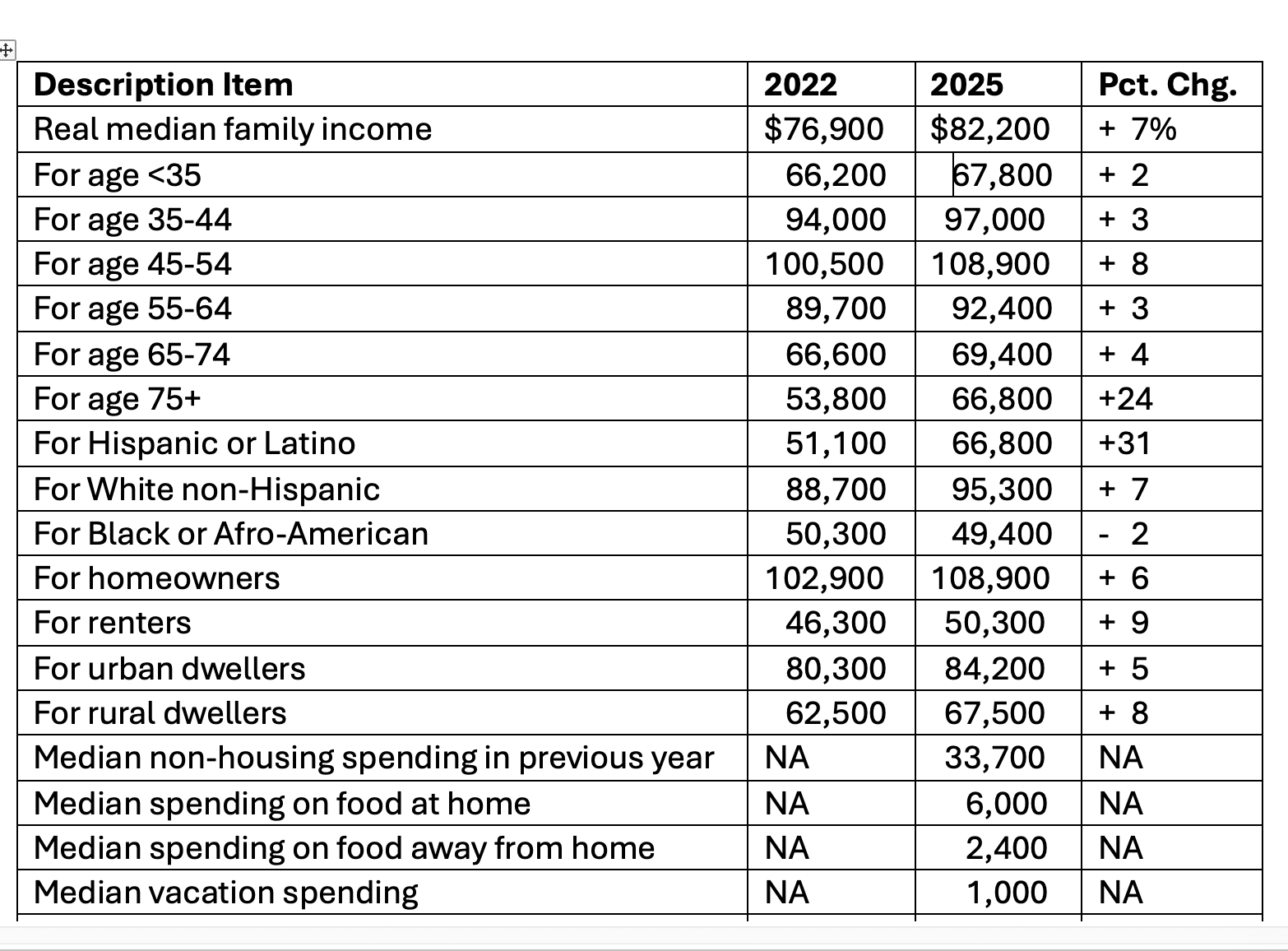
Source: https://www.federalreserve.gov/newsevents/pressreleases/other20261009a.htm
The values in the table reveal a very different America from the one we see on TV or in print media. While real median income rose 7 percent in the reporting period, the median dollar level was still only $82,200. It will go further in a rural area than in a major city. But it’s still not an income that will buy luxury goods.
The two big median increases don’t buy a lot either. Those 75 and older, for instance, enjoyed an income increase of 24 percent, but their $66,800 median income was still lower than the $67,800 income of those under age 35 whose income had risen only 2 percent. Hispanics or Latinos, as a group, enjoyed a 31 percent increase in income. But it still was only to $66,800, far under the overall median family income.
A Striking Absence of Luxury Cruises
The survey’s measures of actual spending are equally striking. Median non-housing spending was less than $3,000 a month, $33,700. Median spending on food at home was $6,000. Median spending on food away from home was $2,400. Not a lot of Starbucks trips there.
Most striking was median vacation spending: $1,000. Not much room for a Viking cruise in that, let alone the private jet to London for Boxing Day or to Tokyo for a relaxed weekend with an origami lesson at a Ryokan, a traditional Japanese inn.
The Difference Pennies Make
The medians explain why penny price changes matter at McDonald’s, Burger King and other major fast-food companies. They also explain why the young are renters, waiting to own. Not to mention the rising popularity of thrift clothing. When it comes to wealth and income, there’s a whole lot more at the top than at the bottom.
That’s not news, of course. But the unrelenting reality of it is news.
Too bad it’s under-reported.
Related columns:
Scott Burns, “The 2026 Wealth Scoreboard,” 10/17/2026: https://scottburns.com/the-2026-wealth-scoreboard/
Sources and References:
Federal Reserve Board releases results of the 2025 Survey of Consumer Finances, 10/09/2026: https://www.federalreserve.gov/newsevents/pressreleases/other20261009a.htm
Katherine Clarke, “The Superrich Are Buying $100 Million Mansions Just to Tear Them Down,” 10/21/2026, https://www.wsj.com/real-estate/luxury-homes/luxury-home-teardowns-370427b9?mod=WSJ_home_feature_5_pos_2
Into Pacheco and Theo Francis, “What We Know About America’s Billionaires: 1,135 and Counting,” 9/2,2025: https://www.wsj.com/finance/investing/what-we-know-about-americas-billionaires-1-135-and-counting-98d22268
Aaron Barnes, “Personal Wealth, 2019,” Spring 2004: https://www.irs.gov/pub/irs-soi/soi-a-inpw-id2402.pdf
This information is distributed for education purposes, and it is not to be construed as an offer, solicitation, recommendation, or endorsement of any particular security, product, or service.
Photo: Scott Burns, Lunch in the Tree House at The Leaning Pear, Wimberly on a perfect October day
(c) Scott Burns, 2026
Scott – This is a very interesting article. Having spent my career track in the non-profit world, the median income doesn’t seem far off from what I would expect for folks in my peer group. Yet for many others in business, I would have anticipated it would have pushed the median income higher. Goes to show that I don’t know much.