As a country, we’re big on homeownership. It’s central to the American Dream. Always has been.
But while our homes are valuable and sometimes (often, actually) become more valuable over time, there is a hitch. They also cost money to own. Yes, we can pay off the mortgage. But we will always have real estate taxes, insurance, utilities and maintenance costs to pay. Those costs can be substantial.
A Fund to Support Your House
While those costs vary from state to state, it’s a reasonable rule of thumb that you need to have the value of your house in financial assets that earn dividends and interest to generate enough income to pay those costs.
That makes the net worth of a household excluding its home equity a very interesting number. It’s a net worth figure that includes financial assets of all sorts (cash, CDs, savings accounts, retirement accounts and investment accounts), but also includes other items such as owning a business, cars and other personal possessions.
Having a net worth excluding home equity that is at least equal to the value of your home is only what it takes to pay the operating costs of your home. All your other expenses must come from some other source.
You Still Have All The Other Bills
Think about that. You’ll also need the income to pay for everything medical, the food you eat, the clothes on your back, the car you drive, communication and entertainment, etc.
For most retirees, their first income source is Social Security benefits. A decreasing number of people have a defined benefit pension. Some will have income from rental property or a private business.
This tells us that having the value of your house in your net worth ex-home equity is a pretty bare bones measure of future financial security. So let’s look at how net worth ex-home equity is distributed over the top 50 percent of all households.
As you can see from the table below, where you are in the distribution of wealth, excluding home equity, can be a problem for supporting the roof over your head. Those in the top 1 percent to top 10 percent don’t have a problem. With a household age 55 to 59 having nearly $2.9 million in assets excluding home equity, the only people who would have a problem having the value of their house in earning assets would be those who overreach or fail to pay off a mortgage before retiring.
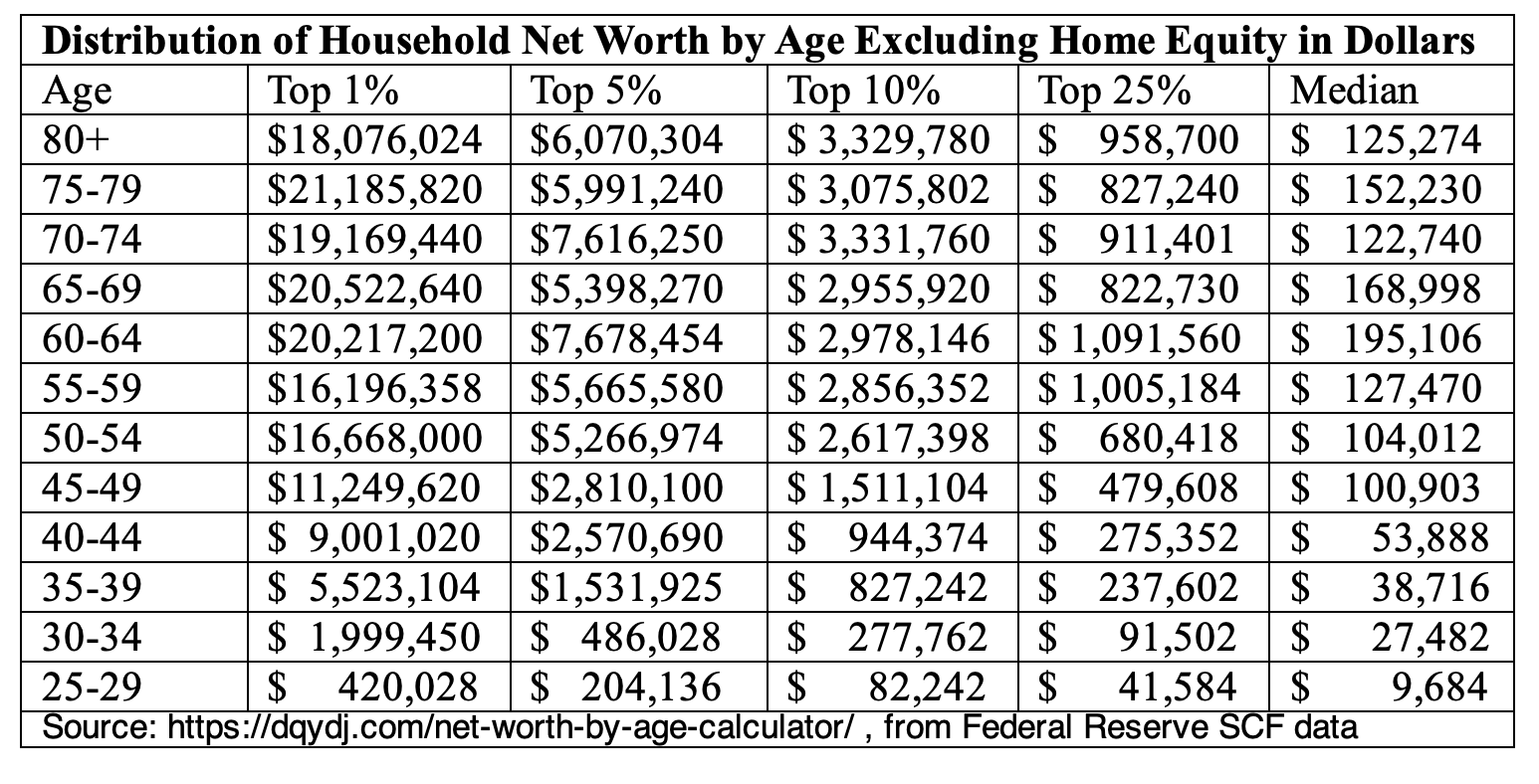
You can see this in the median home sale prices from the National Association of Realtors. Its most recent figures, for the third quarter of this year, show a national median price of $432,900. Since top 25 percent households have a net worth excluding home equity over $1 million by age 55 to 59, we could say the top quartile of American households is in great shape.
But everyone else? Not so much.
That’s a lot of people.
And Houses Cost A Lot More In Some Places Than In Others
The other issue is that the median home value can be a lot higher, or lower, than the national median. According to the NAR figures, the San Jose-Sunnyvale-Santa Clara, Calif. area has a median existing single-family home sale price of $1.92 million. So you’ll probably need to be in the top 10 percent of households to think about retiring there.
Then again, if you can survive the winters in Erie, Pa. — median existing home sales price $224,900 — you can score lower than the top 25 percent of households and have a safely financed retirement.
You could also push it to the furthest extreme and move to Decatur, Ill. It takes the current prize for the lowest existing home median sales price, only $158,100.
Almost half of all households would have the assets to retire there.
Readers who want to see how their area fits with their expected net worth excluding home equity should download the NAR list. It includes more than three pages of metropolitan areas in small print.
The Top Half Needs The Bottom Half
People who are relatively well-off — those in the top 25 percent of all households, are fortunate. But they also need to consider the stability of their wealth. Without the income of the bottom 75 percent of households, our enormous market for consumer goods and services would be impaired. That means the profitability of the companies that produce our consumer goods and services would be impaired. So the future income growth of ALL households is vital.
A similar argument holds for home values. Without a large population of buyers eager to own homes, that enormous source of consumer wealth will be impaired.
Bottom line: We need each other. That means we need government tax and spending policies that help sustain what we all like to call “the American Dream.”
Let’s hope the Blue Wave is smarter than the Orange Wave that just crashed.
Related columns:
Scott Burns, “In America, Our Homes Are The Ball Game,” 2/6/2026: https://scottburns.com/in-america-our-homes-are-the-ball-game/
Sources and References:
National Association of Realtors, Q3 2026 Median Sales Price of Existing Single-Family Homes: https://www.nar.realtor/sites/default/files/2026-10/metro-home-prices-q3-2026-ranked-median-single-family-2026-10-29.pdf
This information is distributed for education purposes, and it is not to be construed as an offer, solicitation, recommendation, or endorsement of any particular security, product, or service.
Photo by Kelly on Pexels
(c) Scott Burns, 2026